

This article may contain affiliate links. We may earn a commission if you book or purchase through them, at no extra cost to you.
Pamukkale is one of the most recognizable places in Turkey, but it is often misunderstood.
Many travelers imagine it as a quick photo stop: white terraces, blue water, a few pictures, and then back to the road. You can visit it that way, but Pamukkale is better when you understand what is actually there.
The white travertines are the reason most people come. But the full site also includes Hierapolis Ancient City, the ancient theatre, the archaeological museum, thermal water areas, and the Antique Pool, often called Cleopatra’s Pool.
So Pamukkale is not only a natural site. It is an area where nature, Roman history, thermal culture, and practical timing all come together.
If you plan it well, it can be one of the most memorable stops in Turkey. If you rush it at the wrong hour, especially in summer, it may feel hotter, brighter, and more tiring than expected.
Quick Answer
Pamukkale is worth visiting if you want to see one of Turkey’s most unusual landscapes and combine it with ancient history.
For most travelers, half a day is enough for a basic visit, but one full day or an overnight stay makes the experience easier, especially if you want to avoid the harshest hours, see Hierapolis properly, or continue toward Kusadasi, Selcuk, or Ephesus.
The main things to see are:
- Pamukkale travertines
- Hierapolis Ancient City
- Hierapolis Theatre
- Antique Pool / Cleopatra’s Pool
- Hierapolis Archaeological Museum
- Necropolis and ancient gates, if you enjoy archaeology
The best time to visit is usually April to June or September to November. In summer, early morning or late afternoon is much more comfortable than midday.
Where Is Pamukkale?
Pamukkale is in Denizli Province in western Turkey.
It is not on the coast, and it is not right next to Ephesus or Kusadasi. This is important because many travelers try to add Pamukkale to an Aegean route without realizing the road time.
Pamukkale is usually connected with:
- Denizli Airport
- Denizli city center
- Kusadasi
- Selcuk and Ephesus
- Izmir
- Antalya, in some longer routes
- Cappadocia (via domestic flights through Kayseri or Nevşehir, or by private transfer)
If you are flying in, the closest airport is Denizli Cardak Airport. From there, you still need a road transfer to reach Pamukkale.
If you are coming from Kusadasi, Selcuk, or Ephesus, expect a real road journey. It is possible, but it should be planned as part of the day, not as a quick side stop.
What Makes Pamukkale Special?
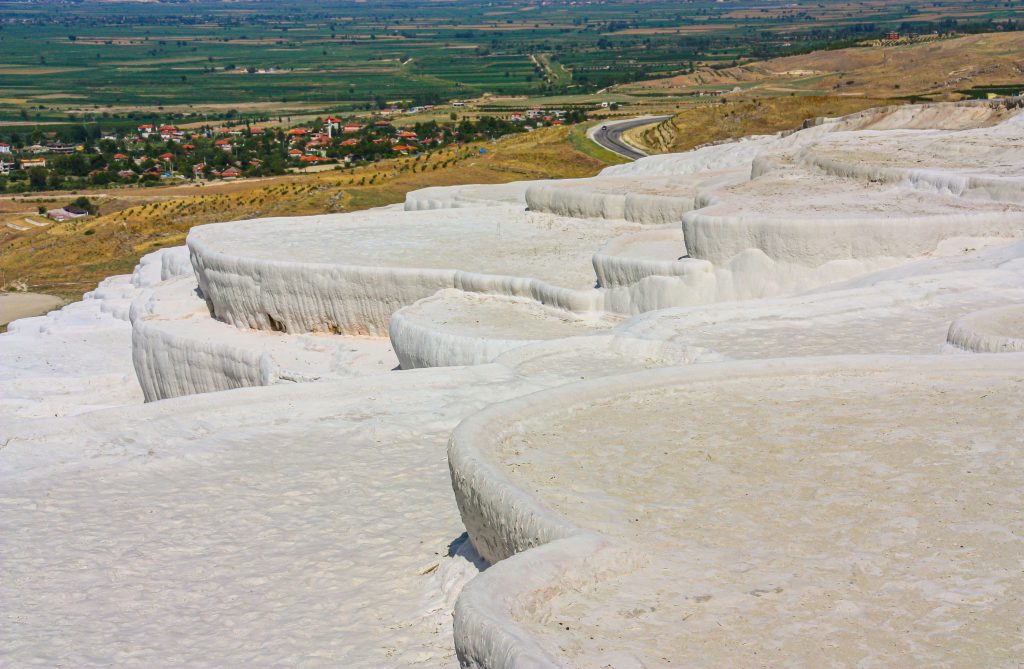
Pamukkale means “cotton castle” in Turkish, and the name makes sense when you see the white terraces from a distance.
The travertines were formed by mineral-rich thermal waters flowing down the slope over a long period of time. The result is a bright white landscape of terraces, pools, and calcium formations.
But the natural landscape is only half of the story.
Right above the travertines is Hierapolis, an ancient city with a long spa and healing tradition. People came here fora the thermal waters centuries ago, and that connection between water and health is still part of Pamukkale’s identity today.
This is why I think Pamukkale should not be treated as just a viewpoint. The best visit connects the travertines with Hierapolis.
That is when the place starts to make more sense.
Main Things to See in Pamukkale
Pamukkale Travertines
The travertines are the main symbol of Pamukkale.
This is the white slope you see in photos, with terraces and shallow pools created by thermal water. Visitors usually walk barefoot on the permitted parts of the travertines to help protect the surface.
The first surprise for many travelers is that the whole area is very bright. On sunny days, the white surface reflects the light strongly. Sunglasses help, and in summer the middle of the day can feel uncomfortable.
Also, do not expect every pool you see online to look exactly the same on your visit. Water flow can be controlled for conservation, and some terraces may look fuller or drier depending on the period.
Pamukkale is beautiful, but it is a living natural site, not a staged swimming pool.
Hierapolis Ancient City
Hierapolis is the ancient city above the travertines.
Some visitors rush past it because they came only for the white terraces. I think that is a mistake if you enjoy history even a little.
Hierapolis gives Pamukkale its deeper context. You can see ancient streets, gates, baths, ruins, and large open areas that show how important this place once was as a thermal and religious center.
The site is spread out, so you do not need to see every corner. But you should leave enough time for at least the theatre area and the main ancient city remains.
Hierapolis Theatre
The ancient theatre is one of the strongest parts of Hierapolis.
It takes some walking to reach it, but the view and the structure are worth the effort. If you only see the travertines and skip the theatre, you miss one of the most impressive parts of the site.
This is also where timing matters. In hot months, walking uphill or across open areas can feel much harder around midday.
If you want to include the theatre, plan your energy, shoes, and water accordingly.
Antique Pool / Cleopatra’s Pool
The Antique Pool is a thermal pool inside the ancient site. It is often called Cleopatra’s Pool, although travelers should understand that the name is mostly part of the popular travel language around the site.
The pool can be a nice experience if you like thermal water and have enough time. It is not necessary for every visitor.
I would see it as an optional extra, not the main reason to visit Pamukkale.
If your schedule is tight, focus first on the travertines and Hierapolis. If you have more time and want a slower visit, the pool can be added.
Also check the current access rules and extra costs before you plan around it, because these details can change.
Hierapolis Archaeological Museum
The museum is useful if you want expanded context.
It is not huge, but it helps connect the ruins with the history of the area. If you enjoy archaeology, it is worth considering. If you are short on time, you may choose to focus on the open-air site instead.
For a quick visit, most travelers prioritize the travertines, theatre, and main Hierapolis area. For a richer visit, add the museum.
How Much Time Do You Need in Pamukkale?
For a very basic visit, you need at least 2 to 3 hours.
That gives you time to walk on the travertines, see some of Hierapolis, take photos, and get a general feeling for the site.
For a better visit, allow 4 to 5 hours.
This gives you more room for the theatre, museum, Antique Pool, and breaks. It also makes the day feel less rushed.
If you are arriving from Denizli Airport and continuing to Kusadasi or Selcuk afterward, Pamukkale can fit into the same day. But this is a full travel day, not a light one.
A good route can be:
Denizli Airport → Pamukkale and Hierapolis → Kusadasi or Selcuk overnight
This works best with an early flight and organized transport.
If you arrive late, stay overnight near Pamukkale and visit the site the next morning.
Best Time to Visit Pamukkale
The best months to visit Pamukkale are usually April to June and September to November.
These months are more comfortable for walking and open-air sightseeing. The light is still strong, but the heat is usually easier to manage than in July and August.
Summer is possible, but timing becomes much more important. Pamukkale is open, bright, and exposed. Midday can feel harsh, especially when you are walking barefoot on the travertines or crossing the ancient city.
In summer when it is hot, I would aim for early morning or late afternoon.
Winter can also work if you are flexible. The site is quieter, and the thermal landscape can still feel special, but weather may be colder or rainy.
Morning or Afternoon: Which Is Better?
If you are staying overnight in Pamukkale, early morning is usually a good choice.
The light is softer, the air is cooler, and the site may feel calmer before the day gets busy.
Late afternoon can also be beautiful, especially for photos and softer light. This can work well if you arrive from another city during the day.
Midday is the hardest time, especially in summer. It is not impossible, but it can make the visit feel more tiring than it needs to be.
If your itinerary forces you to visit around midday, keep your expectations realistic. Wear a hat, bring water, use sunglasses, and do not try to walk every corner of the site.
Should You Stay Overnight in Pamukkale?
You do not always need to stay overnight, but it can make the visit easier.
An overnight stay is useful if:
- you arrive late from Denizli Airport
- you want to visit early in the morning
- you want a slower pace
- you are traveling with children or older travelers
- you do not want to combine too many transfers in one day
- you want to continue to Kusadasi, Selcuk, or Ephesus the next day
If you are short on time, you can visit Pamukkale and continue to another destination on the same day. Many travelers do this.
But if you want the experience to feel less rushed, one night near Pamukkale or Karahayit helps.
Pamukkale or Karahayit: Where Should You Stay?
Pamukkale town is more practical for visiting the travertines and Hierapolis.
It is closer to the main site area and works well for travelers who want simple access, a short stay, and an early visit.
Karahayit is known for thermal hotels. It can be better if you want a larger hotel, spa-style facilities, or a more thermal-focused stay.
The choice depends on your priority.
If your main goal is sightseeing, Pamukkale town is usually more convenient.
If your main goal is a thermal hotel experience, Karahayit may make more sense.
Just be careful when booking transfers. Pamukkale and Karahayit are close, but they are not the same exact place.
How to Get to Pamukkale
From Denizli Airport
Denizli Cardak Airport is the closest airport to Pamukkale.
The airport is still around an hour away by road, so you need a transfer after landing. A private transfer or shared shuttle is usually the easiest option. A taxi can also work, but the price should be clear before you leave.
Public transport through Denizli city may be cheaper, but it is less convenient with luggage or late arrivals.
From Kusadasi, Selcuk or Ephesus
Pamukkale can be combined with Ephesus and Kusadasi, but the distance should not be underestimated.
A common route is:
Pamukkale → Kusadasi or Selcuk → Ephesus
or the reverse:
Kusadasi or Selcuk → Pamukkale
Both can work, but this is not a tiny local transfer. If you are trying to visit Pamukkale and continue to another place on the same day, keep the plan realistic.
From Istanbul
From Istanbul, the fastest option is usually to fly to Denizli and continue by road to Pamukkale.
This works especially well if Pamukkale is part of a 7-day or 10-day Turkey itinerary.
Taking a bus from Istanbul is possible, but for a short trip, it usually uses too much time.
From Antalya
Pamukkale can also be reached from Antalya by road.
This route may fit longer Turkey itineraries, especially if you are connecting the Mediterranean coast with western Turkey. But it is not a short day, so plan the drive carefully.
Can You Visit Pamukkale as a Day Trip?
Yes, but it depends where you are starting from.
From Denizli, it is easy.
From nearby areas like Kusadasi, Selcuk, or Izmir, it is possible but long. You need to think about road time, site time, and the return journey.
From Istanbul, Pamukkale is not a simple day trip unless you fly and keep the plan very tight. I would usually avoid treating it as a casual same-day visit from Istanbul.
Pamukkale works better when it is part of a route.
For example:
Istanbul → Denizli Airport → Pamukkale → Kusadasi / Ephesus → Cappadocia
This kind of plan makes more sense than flying in and out just for a rushed stop.
What to Wear and Bring
Pamukkale is not difficult to visit, but a few small things make the day easier.
Bring sunglasses. The white surface reflects light strongly.
Wear comfortable shoes for Hierapolis, because the ancient city involves walking on uneven ground. For the travertines, you will need to walk barefoot in permitted areas, so shoes that are easy to remove are helpful.
In summer, bring a hat and water. Do not underestimate the sun.
A small towel can be useful if you want to dry your feet after walking on the travertines.
Swimwear is only needed if you plan to use the Antique Pool or your hotel’s thermal facilities.
Common Mistakes to Avoid
Treating Pamukkale as only a photo stop
The travertines are beautiful, but Hierapolis is part of the experience. If you have time, do not skip it.
Visiting at the worst hour in summer
Midday in July or August can make the visit feel much harder. Early or late visits are usually better.
Forgetting the walking
Pamukkale looks simple in photos, but the full site involves walking, sun, uneven ground, and open spaces.
Planning a tight onward journey
If you have to continue to Kusadasi, Selcuk, Izmir, or the airport, leave enough time. The road journey matters.
Expecting every pool to look like Instagram
The travertines are a protected natural site. Water levels and access areas can change. The real place is still beautiful, but it may not look exactly like a filtered photo.
My Practical Recommendation
If Pamukkale is part of your first Turkey trip, I would not overcomplicate it.
Arrive with enough time. Visit the travertines and Hierapolis together. Do not skip the theatre if you have the energy. Add the Antique Pool only if you genuinely want the thermal experience and have time.
If you are connecting Pamukkale with Ephesus, the route can work very well. Fly to Denizli, visit Pamukkale, continue to Kusadasi or Selcuk, and visit Ephesus the next day.
That is a practical way to include Pamukkale without treating it as a rushed detour.
The key is timing. Pamukkale is not hard to visit, but the hour of the day and the route before and after can change the whole experience.
FAQ
Is Pamukkale worth visiting?
Yes, Pamukkale is worth visiting if you are interested in unusual landscapes, ancient history, or classic Turkey routes. It is especially worthwhile when you visit both the travertines and Hierapolis.
How many hours do you need in Pamukkale?
For a basic visit, allow 2 to 3 hours. For a better visit with Hierapolis Theatre, the museum, Antique Pool, and breaks, allow 4 to 5 hours.
Can you visit Pamukkale and Ephesus in one day?
It is possible in some private or very tight plans, but I would not recommend it for most travelers. Both places deserve time, and the road journey between them is not short. It is usually better to visit Pamukkale one day and Ephesus the next.
Should I stay overnight in Pamukkale?
You do not always need to, but staying overnight makes the visit easier if you want an early morning visit, a slower pace, or a smoother route toward Kusadasi, Selcuk, or Ephesus.
What is the best time of day to visit Pamukkale?
Early morning or late afternoon is usually better, especially in warm months. Midday can be bright, hot, and tiring.
Can you swim in Pamukkale?
You cannot swim freely all over the travertines. Access is controlled to protect the site. If you want a thermal swimming experience, check the Antique Pool / Cleopatra’s Pool rules and costs for your travel date.
Do you need shoes for Pamukkale?
You need comfortable shoes for Hierapolis, but on the travertines visitors usually walk barefoot in permitted areas to protect the surface.
Is Pamukkale good for children or older travelers?
It can be, but plan carefully. The site has sun, walking, uneven ground, and some uphill sections. Avoid the hottest hours and keep the visit realistic.
Is Karahayit the same as Pamukkale?
No. Karahayit is a nearby thermal hotel area. It is close to Pamukkale, but it is not the same as staying right beside the travertines.
What airport should I use for Pamukkale?
Denizli Cardak Airport is usually the closest and most practical airport for Pamukkale. From the airport, you still need a road transfer to reach the site or your hotel.
Related guides
Related Guides
Ephesus and Pamukkale in One Trip: How to Plan It
A practical guide to visiting Ephesus and Pamukkale in one trip, including how many days you need, route order, overnight stays and one-day options.
Read more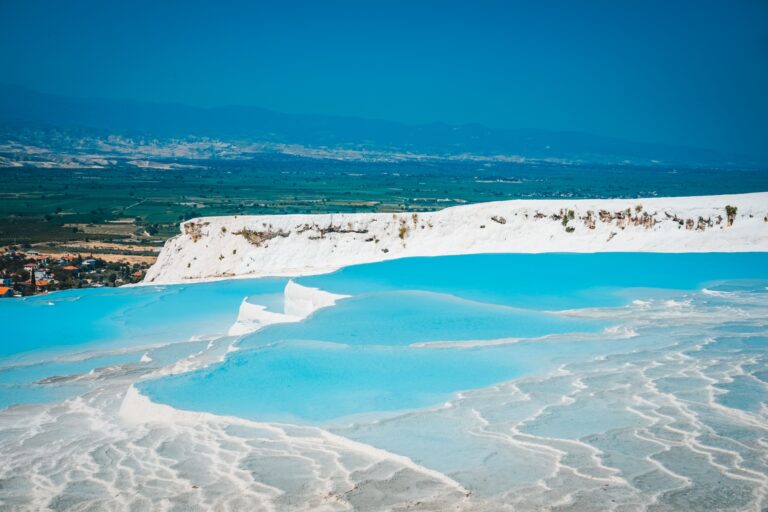
Is Pamukkale Worth Visiting? A Practical Guide for First-Time Visitors
A practical guide to deciding whether Pamukkale is worth visiting, with advice on the travertines, Hierapolis, crowds, timing and route planning.
Read more
10 Days in Turkey Itinerary
Ten days in Turkey is a very good amount of time for a first trip. You still cannot see everything. Turkey is a large…
Read moreNext steps
Continue Planning Your Turkey Trip
Explore practical destination guides, airport routes, itineraries, and travel planning advice.